
Risk-based HCC surveillance in MASLD using non-invasive tests
Lai JC et al, Gut. 2025;74(12):2050-2057
This study demonstrates that non-invasive markers such as the FIB-4 score and liver stiffness measurement can reliably predict hepatocellular carcinoma risk in patients with MASLD. Defined thresholds help identify those who may benefit most from surveillance, for example with FIB-4 ≥ 3.25 or elevated liver stiffness. The findings support a more targeted, risk-adapted approach to HCC surveillance rather than broad screening.
Background: Metabolic dysfunction-associated steatotic liver disease (MASLD) affects over 30% of the general population and is the fastest growing cause of hepatocellular carcinoma (HCC). Current guidelines recommend HCC surveillance in patients with cirrhosis when annual HCC incidence exceeds 1% without specifying the role of non-invasive tests in patient selection.
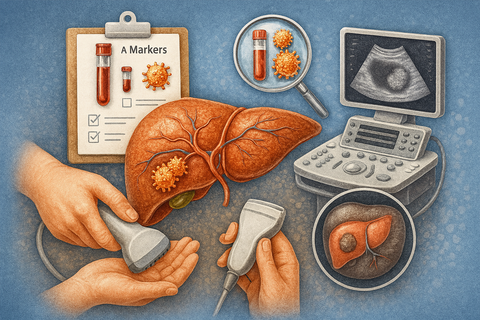
Objective: To define non-invasive test thresholds to select patients with MASLD for HCC surveillance.
Design: A multicentre longitudinal study of adults with MASLD from 16 tertiary centres in the USA, Europe and Asia between February 2004 and January 2023. Primary outcome was incident HCC.
Results: 12,950 patients had Fibrosis-4 index (FIB-4) and liver stiffness measurement (LSM) (mean age 51.7 years; 41.1% male). At a median follow-up of 47.7 (IQR, 23.3–72.3) months, 109 (0.8%) developed HCC. FIB-4 was below the low cut-off (< 1.3 if aged < 65 years and < 2.0 if aged ≥ 65 years), between the low cut-off and < 2.67, 2.67 to < 3.25, and ≥ 3.25 in 66.3%, 23.9%, 3.4% and 6.4% of patients; the corresponding annual HCC incidence was 0.07%, 0.17%, 0.77% and 1.18%. As a stand-alone test, the annual HCC incidence exceeded 0.2% for LSM ≥ 10 kPa and 1% for LSM ≥ 20 kPa. If LSM was performed as a second step only among patients with FIB-4 above the low cut-off, the annual HCC incidence exceeded 0.2% for LSM ≥ 10 kPa and 1% for LSM ≥ 15 kPa.
Conclusion: HCC surveillance should be offered to patients with MASLD with FIB-4 ≥ 3.25 or LSM ≥ 20 kPa. When a two-step approach is adopted, LSM ≥ 15 kPa in patients with increased FIB-4 predicts a high HCC risk.