
Questionable value of minor papillotomy in unexplained recurrent acute pancreatitis and pancreas divisum
Coté GA et al, JAMA. 2026;335(8):682-692
In this multicenter randomized study of patients with recurrent unexplained acute pancreatitis and pancreas divisum, endoscopic papillotomy of the minor papilla did not reduce the risk of another episode of acute pancreatitis or related sequelae as compared to sham therapy.
Importance: Pancreas divisum is implicated as an obstructive cause for acute pancreatitis. Observational data suggest endoscopic retrograde cholangiopancreatography (ERCP) with minor papillotomy reduces the risk of pancreatitis episodes. Even though this endoscopic procedure is widely used in practice, clinical trials are lacking.
Objective: To determine whether ERCP with minor papillotomy reduces the risk of acute pancreatitis among adults with unexplained acute recurrent pancreatitis and pancreas divisum.
Design, setting, and participants: This multicenter, sham-controlled, double-blind randomized clinical trial enrolled adults with 2 or more episodes of acute pancreatitis and pancreas divisum. Adults with other etiologies for acute pancreatitis or concomitant chronic calcific pancreatitis were excluded. The trial was conducted between September 1, 2018, and August 30, 2024, at 21 referral centers in the US and Canada. Last follow-up occurred on February 15, 2025.
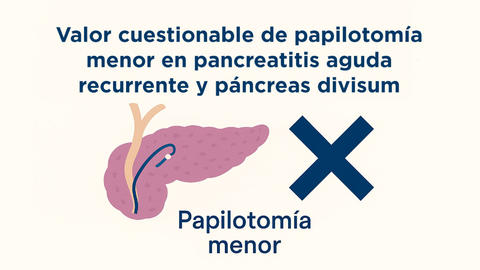
Intervention: Participants were randomized in a 1:1 ratio to ERCP with minor papillotomy or sham ERCP.
Main outcomes and measures: The primary outcome was development of acute pancreatitis more than 30 days after randomization as a time-to-event outcome. The secondary outcomes included acute pancreatitis episode frequency and development of chronic calcific pancreatitis, diabetes, and exocrine pancreatic dysfunction.
Results: A total of 148 participants were randomized (mean age, 54 [SD, 19.5] years; 68.2% female; 95.3% non-Hispanic or Latino and 87.2% White; mean lifetime acute pancreatitis episodes, 3 [SD, 2]; mean duct diameter, 2.2 [SD, 1.3] mm) and followed up for a median of 34 months (IQR, 21.7–45.7 months). Of the 75 participants in the ERCP with minor papillotomy group, 26 (34.7%) developed acute pancreatitis compared with 32 of 73 participants (43.8%) in the sham ERCP group (adjusted hazard ratio = 0.83 [95% CI: 0.49–1.41]). The incidence rate ratio for acute recurrent pancreatitis episode frequency was 0.25 (95% CI: 0.18–0.34) in the ERCP with minor papillotomy group vs 0.30 (95% CI: 0.23–0.41) in the sham ERCP group. There were no between-group differences in frequency and incidence of chronic calcific pancreatitis (4.0% in the ERCP with minor papillotomy group vs. 2.7% in the sham ERCP group; risk difference [RD], 0.01 [95% CI: -0.05 to 0.07]), diabetes (15.8% vs. 12.8%, respectively; RD, 0.03 [95% CI: -0.13 to 0.19]), and exocrine pancreatic dysfunction (7.7% vs. 17.2%; RD, -0.10 [95% CI: -0.27 to 0.08]). The adverse event of acute pancreatitis within 30 days of randomization occurred more frequently in the ERCP with minor papillotomy group (14.7%) vs. the sham ERCP group (8.2%) (RD, 0.06 [95% CI: -0.04 to 0.17]).
Conclusions and relevance: Among patients with unexplained acute recurrent pancreatitis and pancreas divisum, ERCP with minor papillotomy does not reduce the risk of another episode of acute pancreatitis or related sequelae.