
Prevalence of liver fibrosis in the European general population
Graupera I et al, Lancet. 2026;407(10537):1448-1458
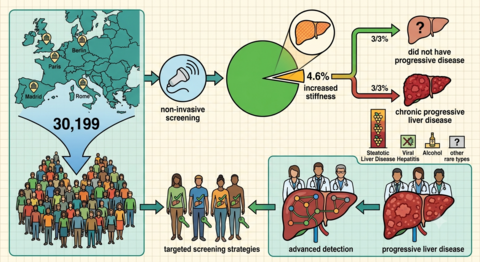
In the multinational European LiverScreen study, including 30,199 participants, the prevalence of liver fibrosis in the general population was assessed using non-invasive screening methods. Increased liver stiffness was detected in 4.6% of individuals, and approximately one-third of these were subsequently confirmed to have chronic progressive liver disease. Steatotic liver disease was by far the most common underlying etiology. These findings support targeted screening strategies for the early detection of advanced liver disease.
Background: Small scale, single-country studies suggest that undiagnosed liver fibrosis is prevalent in the general population; however, its true burden and main risk factors remain unclear. We aimed to assess the prevalence of undiagnosed liver fibrosis and its relationship with metabolic factors or alcohol consumption in a large prospective population-based multinational cohort study.
Methods: We enrolled individuals from the general population who were aged 40 years and older across 35 sites, including primary health centres and screening units, and their 16 affiliated tertiary hospitals in nine European countries. Liver fibrosis was estimated using the liver stiffness measurement (LSM) by vibration-controlled transient elastography (VCTE). A positive test was defined as an LSM of 8 kPa and greater or an alanine aminotransferase concentration of at least 1.5 the upper limit of normal, or a combination of both. Individuals with at least one criterion were referred for hepatology consultation to confirm chronic liver disease with fibrosis. The primary outcome was the prevalence of LSM of 8 kPa and greater.
Findings: We enrolled 30,199 individuals (mean age 58 years; 57% [17,203 of 30,199] women, 89% [24,440 of 27,481] White) from nine European countries. Metabolic factors were present in 70% (21,084 of 30,024) of participants, and 59% (15,107 of 25,488) of participants reported alcohol use, with 6.1% (1771 of 29,081) of participants reporting harmful consumption. The positive screening rate was 6.9% with a prevalence of 4.6% with an LSM of 8 kPa and greater. Elevated LSM was strongly associated with obesity, type 2 diabetes, and harmful alcohol use. Of the participants referred, 61% (1491 of 2457) completed a hepatology evaluation, and chronic liver disease with fibrosis was confirmed in 32% (477 of 1491) of participants, yielding an overall estimated prevalence of 1.6% (477 of 30,199). Steatotic liver disease accounted for 93% (443 of 477) of cases.
Interpretation: Undiagnosed liver fibrosis is common in the general population in Europe and is primarily driven by metabolic factors and alcohol consumption. Early detection is pivotal as it could allow personalised interventions that can prevent progression to cirrhosis and complications.