
Perturbations of diet and gut signatures persist during remission in Crohn’s disease (CD) despite effective immunosuppression
Braun T et al, Gastroenterology. 2026;170(5):971-984
Analysis of diet, microbiome metabolomics, ileal transcriptomics and clinical data revealed that signature perturbations associated with active inflammation also persist during remission. These findings underline a potential explanation for the remitting-relapsing nature of CD and suggest that interventions targeting these parameters may promote deeper remission states.
Background and aims: We aimed to identify dietary and gut signals during Crohn's disease (CD) remission that differ from the healthy state to highlight targets that may improve disease control and clearance
Methods: We analyzed diet, ileal transcriptomics, microbiomics, and metabolomics across patients with CD in remission, patients with active CD, and non-inflammatory bowel disease (IBD) controls as the reference for healthy signals.
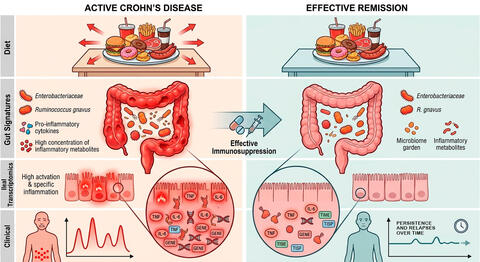
Results: One hundred ninety one subjects were included; 77 CD patients in remission, 37 with active CD, and 77 non-IBD controls. Ileal transcriptomics revealed a significant decrease in genes and pathways associated with adaptive T cells and innate granulocytes during remission, which was even deeper than observed in non-IBD controls. Despite this observed immune suppression, patients in remission showed an increase in the expression of epithelial antimicrobial pathways and related genes, including DUOX2, along with an increase in genes associated with goblet cells and mucin glycosylation. These signals during remission coincided with a persistent pathogenic gut microbial composition, metabolic alterations, and less healthy dietary habits, which were characterized by a higher intake of ultraprocessed foods and lower consumption of fiber, folate, vitamin C, and vegetables. Greater exposure to ultraprocessed foods was significantly associated with more dysbiotic gut signals and negatively correlated with genes enriched for mucin glycosylation, which is essential for maintaining gut barrier homeostasis.
Conclusions: Perturbations in dietary, ileal, microbial, and metabolic signatures persist during CD remission despite advanced, effective immune treatments. These findings likely underline the remitting-relapsing nature of CD and suggest that interventions targeting diet, epithelial health, and microbial and metabolic functions may promote deeper, longer-lasting remission states.