
Ileocecal resection versus infliximab for ileal Crohn's disease – Retrospective 10-year follow-up of the LIR!C trial
Oldenburg L et al, Lancet Gastroenterol Hepatol. 2026;11(4):314-322
Patients who had ileocecal resection had better 10-year therapy-free remission rates than those who received infliximab. Rates of clinical remission were comparable in both groups with a suggestion that younger patients (< 20 years) derived greater benefit than older patients in terms of sustained clinical remission.
Background: The LIR!C trial showed that laparoscopic ileocaecal resection is an effective alternative to infliximab therapy with similar quality-of-life outcomes in patients with uncomplicated ileocaecal Crohn's disease who had not responded to conventional treatment. The study aimed to assess the 10-year outcomes of participants in the trial, focusing on the long-term therapy-free and clinical remission rates of both interventions.
Methods: In this retrospective follow-up study, the authors included patients who participated in the LIR!C trial, a multicentre randomised controlled trial that compared ileocaecal resection to infliximab treatment in adult patients with non-stricturing and immunomodulator-refractory ileocaecal Crohn's disease. They obtained data from the end of the LIR!C study to the latest follow-up visit with either the gastroenterologist or gastrointestinal surgeon. They recorded events including initiation or switch of Crohn's disease-related treatments and (re-)resections. In this follow-up, outcomes of interest were therapy-free remission (defined as clinical remission without the initiation of Crohn's disease-related therapy in the ileocaecal resection group and discontinuation of infliximab in the infliximab group, compared between groups using bootstrapping) and clinical remission (defined as the absence of changes in Crohn's disease-related therapy or the need for additional resection in both groups, compared between groups using Cox regression). Post-hoc flexible parametric survival modelling was used to investigate potential age-dependent effect modification of ileocaecal resection versus infliximab for 10-year clinical remission rates.
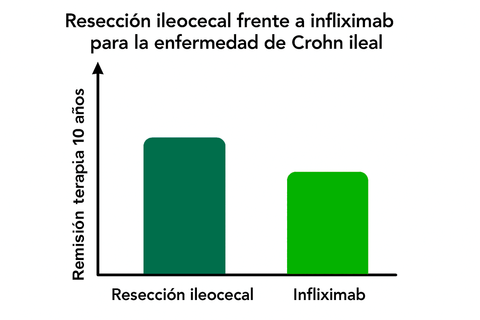
Findings: Follow-up data were available from 129 (90%) of the 143 patients included in the LIR!C trial, of whom 66 were in the ileocaecal resection group and 63 were in the infliximab group. 85 (66%) of patients were female and 44 (34%) were male. Median age at randomisation was 28 years (IQR, 23–41). Median follow-up was 11 years (IQR, 9–14). 10-year therapy-free remission rate was 35.8% (95% CI: 25.6–50.1) in the ileocaecal resection group, compared with 13.2% (6.1–23.2) in the infliximab group (difference 22.6%, 95% CI: 7.8–36.8; p = 0.0038). Overall 10-year clinical remission rates were similar in the ileocaecal resection and infliximab groups (36.5%, 95% CI: 26.2–50.8 vs. 28.4%, 18.9–42.5; hazard ratio = 0.79, 95% CI: 0.52–1.20; p = 0.27). However, exploratory interaction analyses suggested an age-dependent effect of ileocaecal resection on clinical remission rates (pinteraction=0.020). The estimated 10-year clinical remission rate for a 20-year-old patient was 54% (95% CI: 37–72) with ileocaecal resection versus 24% (12–44) with infliximab (difference 30%, 95% CI: 7–53), compared with 38% (27–53) with ileocaecal resection versus 28% (18–43) with infliximab for a 30-year-old patient (difference 10%, -6 to 26).
Interpretation: Patients who had ileocaecal resection had better 10-year therapy-free remission rates than those who received infliximab, with a suggestion that younger patients derived greater benefit than older patients in terms of sustained clinical remission. These findings support ileocaecal resection as an attractive early treatment option for ileal Crohn's disease in the early disease course.