
ANTICIPATE-NASH: Prognostic models outperform histology
Aceituno L et al, Gastroenterology. 2026;170(2):385-394
By combining non-invasive parameters, the ANTICIPATE-NASH models allow a more refined risk stratification for decompensation and other clinical outcomes. This study shows that these models predict the risk of clinical events in patients with MASLD and advanced chronic liver disease more accurately than histology alone. These findings highlight the potential of non-invasive prognostic tools for guiding clinical management.
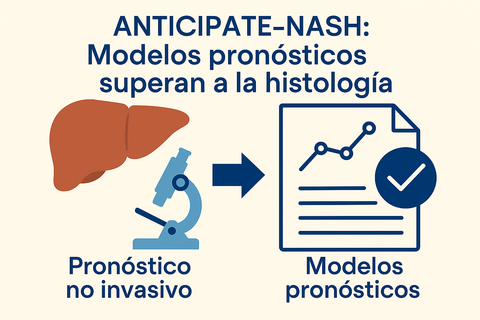
Background and aims: The reference for risk stratification and clinical trial selection of metabolic dysfunction-associated steatotic liver disease (MASLD) patients is fibrosis degree by histology. The noninvasive ANTICIPATE-NASH models have been validated for risk prediction of clinically significant portal hypertension (CSPH) and liver-related events (LRE). We assessed whether these models provide better risk stratification of events than histology.
Methods: A multicenter cohort 1, including 699 biopsy specimen-proven F3-F4 patients with MASLD was evaluated. The end point was LRE (hepatic decompensation, hepatocellular carcinoma, transplantation, or liver-related death). We assessed (Cox regression) whether histology provided added value to ANTICIPATE-NASH and whether model predictions differed in F3/F4 patients. Results were validated in cohort 2 (1396 F3–F4 patients) from 4 clinical trials using the clinical regulatory end point.
Results: In cohort 1, F3 and F4 were equally distributed. There were 56 LREs (8.0%) during follow-up, concentrated in F4 (51 LREs). The ANTICIPATE-NASH model showed excellent discrimination (C statistic, 0.93) for LRE, higher than histology (C statistic, 0.67). Model calibration was excellent. Adding histology did not improve model prediction. Thresholds of ANTICIPATE-NASH above which F3 patients developed LREs and below which F4 patients did not were identified. Results were reproduced in cohort 2 with the regulatory end point, with higher model discrimination (C statistic, 0.84) compared with histology (C statistic, 0.64).
Conclusions: In MASLD patients with F3/F4, the noninvasive ANTICIPATE-NASH models provide better risk stratification of clinical events than histologic classification. These models could be very useful for clinical trials by selecting patients at risk of clinical events and patients with higher chances of observed cirrhosis regression.